
Sealed-Bid Auction
Sealed-Bid Call for Proposals
License Terms & Availability
Up to 50 non-exclusive licenses are being offered to panel manufacturers serving the solar farm market.
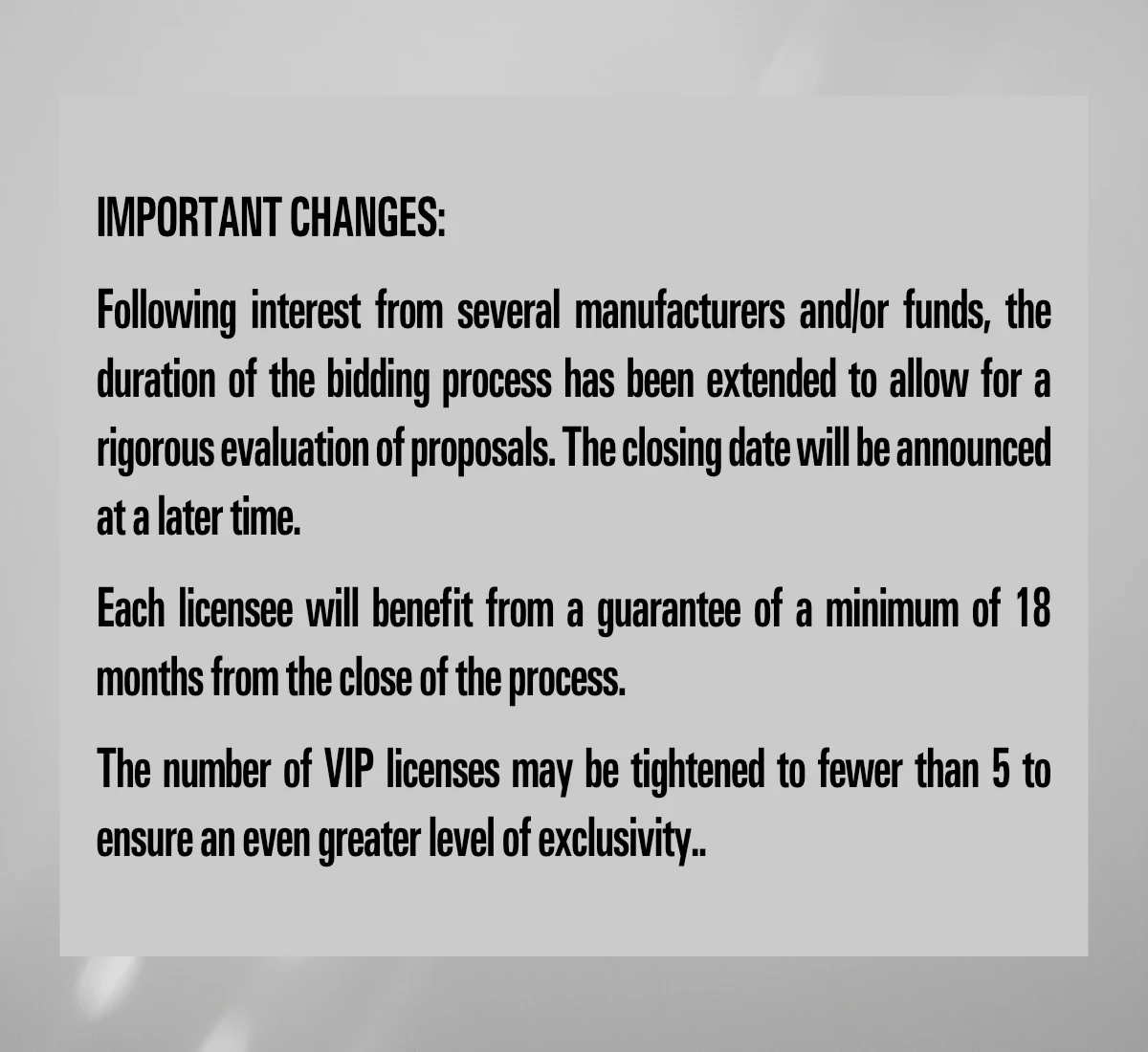
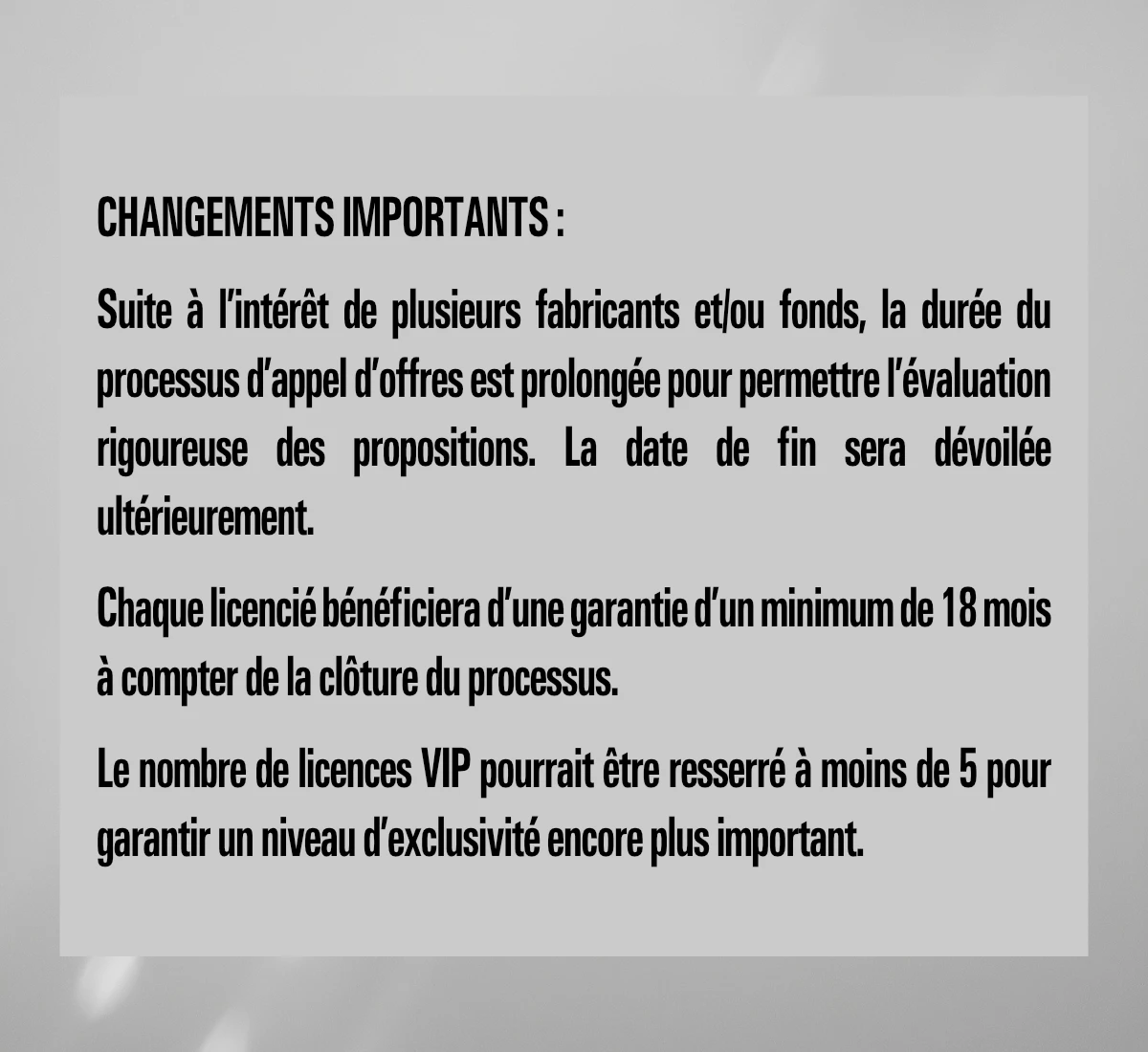
No additional licenses will be made available before spring 2028. Each licensee will benefit from a minimum 18-month guarantee from the close of the process.
Submission Guidelines
- Submit a sealed bid.
- No reserve price is required.
- You are free to submit as many proposals as you wish for any of the license categories.
All proposals will be considered by reflect10, which reserves the right to refuse them.

Registration / Data Room Access Fee: €200,000
Based on information known to date, manufacturers licensed by reflect10 could potentially nearly triple the output of their panels during critical hours. And thanks to the proposed business model, they could collect royalties for 35 years on the revenue generated by the energy surplus produced through "reflectricity."
IPVF Confirmation
After analyzing the physical principles of this technology, the IPVF — Institut Photovoltaïque d'Île-de-France, whose founding shareholders include EDF, TotalEnergies, Air Liquide, CNRS, École Polytechnique, Horiba, and Riber — issued an official scientific opinion on May 7, 2026 (ref. IPVF-2026-DG-009), co-signed by two senior authorities.
"Reflectricity operates within the geometric optics regime, governed by Snell-Descartes laws. This results in an average daily gain on the order of +20%, a better spread of the production curve throughout the day, and a higher photovoltaic surface density for the same installation footprint. In this context, the ×2.66 multiplication factor in the morning and late afternoon is expected." — Mr. Pere Roca i Cabarrocas, IPVF Scientific Director, CNRS Research Director — École Polytechnique, CNRS Silver Medal (2011)
"The INO-262879 R01 report from March 2026, produced by the Institut National d'Optique in Canada using Ansys Zemax OpticStudio software, is rigorous and presents a clear analysis of the possible gains. The modeling indicates a collected optical power ratio of approximately 1.20 over a full day under direct light, and approximately 1.19 under diffuse light — that is, an average daily gain on the order of +20% and +19% respectively, compared to a flat panel of the same footprint. These gains, obtained through an architectural modification of the module without altering the cell itself, represent a significant departure from the industry's usual pace of improvement." — Roch Drozdowski-Strehl, CEO of IPVF
The complete scientific opinion is available in the data room after registration.
A Considerable Breakthrough
For 72 years (1954–2026), the global solar industry has progressed on average by +0.18 percentage points of efficiency per year under real-world field conditions — going from 6% to 19%, or +13 points over 72 years of research targeting cell chemistry.
"To draw a comparison, I would say that for 72 years, experts have tried to build a better engine so the car goes faster. We bet everything on aerodynamics instead. Without touching the engine." — Louis Massicotte, inventor of reflectricity
"Reflectricity" bets on physics rather than chemistry, on the shape of the module rather than on improving the cell.
According to an IPVF scientific opinion, "reflectricity" would produce a +20% gain — a leap equivalent to more than a century of incremental industrial progress (20% ÷ 0.18 = 111 years), compressed into a single architectural innovation, applicable to all types of photovoltaic cells without modifying them.
During the critical morning and evening hours, the ×2.66 factor confirmed by IPVF — a +166% relative production increase — makes this calculation staggering: at a rate of 0.18% per year, it would take centuries, not decades, to reach an equivalent gain through cell improvement alone.
These figures do not compare chemical efficiencies. They measure the gap between two approaches: improving the chemistry of the cell, or changing the geometry of the module.
COP28 called on the world to triple its renewables. Rather than building three times more solar farms, the invention of "reflectricity" surfaces an additional strategic target: beyond building new farms, it helps increase the output of existing farms (in the morning and late in the day) by replacing panels with a new technological generation driven by an intelligent geometry that IPVF has validated.
What Reflectricity Is
"Reflectricity" is a new photovoltaic architecture designed in Quebec City, Canada.
It does not modify the solar cell. It changes the geometry of the panel: a three-dimensional structure that, according to the universal laws of Snell-Descartes geometric optics, multiplies internal reflections and increases the probability of each photon being absorbed. In short, this method aims to let reflections produce more electricity.
Reflectricity does not create energy. It captures more of the energy that flat panels were letting pass through.
This technology would be compatible with existing cell technologies — PERC, TOPCon, HJT, BC. Every future cell improvement could amplify reflectricity's gains.
The Evidence — Four Independent Sources
These 4 documents are accessible in the data room to registered candidates or to those who have submitted a proposal accepted by reflect10.
-
Institut Photovoltaïque d'Île-de-France (IPVF) — Scientific Opinion, May 7, 2026
IPVF issued an official scientific opinion (ref. IPVF-2026-DG-009) confirming:- An average daily production gain on the order of +20%
- ×2.66 (+166%) during morning and evening hours
- +19% under diffuse light (clouds, smog)
Confirmed scale invariance: the principle applies to all industrial formats
"This results in scale invariance: if a given design shows a production gain on a small module, then a geometrically similar module of larger size will show the same production multiplication factor." — Pere Roca i Cabarrocas, IPVFIPVF further confirms two characteristics of immediate practical interest: increased production during hours of highest demand, and higher photovoltaic surface density for the same installation footprint.
-
Institut National d'Optique du Canada (INO / Luqia) — Zemax Simulations, March 2026
INO conducted independent simulations using the professional software Ansys Zemax OpticStudio 2025, confirming the ×2.66 factor at a precise elevation angle in the morning and late afternoon. Report ref. INO-262879 R01. -
International Search Report — CIPO / WIPO, 2026
The Canadian Intellectual Property Office (CIPO), mandated under the Patent Cooperation Treaty (PCT / WIPO), has already concluded the following for one of the three PCT applications: 18 out of 18 claims were found to be novel, inventive, and industrially applicable. No objections. Without exception. -
Field Attestation — E3C Consulting, Morocco, June 18, 2026
Jean-Philippe Goutte, Level 7 certified engineer (France), Director of E3C — Économie & Efficacité Énergétique Consulting (ICE: 003560563000044), attests to having personally observed more than 1,800 hours of field trials and analysis under real-world conditions on two continents (Morocco, ~33°N; Canada, ~47°N) in 2025 and 2026. These trials demonstrated trends that validate the thresholds confirmed by IPVF.
The performance documented in this document — +20%, ×2.66, +19% — was observed by an independent expert using proof-of-concept prototypes over 9 months on two continents.
A New Economic Model for the Solar Industry
The royalty model — a potential multi-year return
The reflect10 license is not a simple patent license. It grants the licensed manufacturer the opportunity to collect recurring royalties on the market value of the additional energy produced by every solar farm equipped with its panels, which it must maintain, service, or replace. Under the proposed structure, the solar farm would retain 75%, while the manufacturer and reflect10 would each receive 12.5%.
This would be made possible through the following proposed mechanism: every kilowatt-hour produced in surplus — beyond the output of a flat panel of the same size — generates a royalty shared between the farm operator, the licensed manufacturer, and reflect10. The better the licensee's manufactured panels perform once installed at the operator's site, the higher the licensee's royalties.
The proposed model creates a structural alignment of interests across the entire value chain:
- The manufacturer wants its warrantied panels to perform well over the long term, since it is compensated based on their actual output over several years
- The operator wants to install durable panels, as it expects to receive benefits from a large share of every additional kilowatt-hour
- reflect10 wants the entire system to be continuously optimized, since its own royalties depend on that optimization
For more than 70 years, the flat panel was sold, installed, and forgotten. With reflect10's technology, a panel becomes a long-term asset for its manufacturer.
Submit a sealed bid. No reserve price is required.
The reference transaction: Aiko / Maxeon — USD $238M
For comparison, reflect10 refers candidates to the only recent and publicly documented solar licensing transaction: Shanghai AIKO Solar Energy to Maxeon Solar Technologies, February 6, 2026.
| Criterion | Aiko / Maxeon | Reflect10 Wave 1 |
|---|---|---|
| Price | USD $238M | Open market, no reserve price |
| Term | 5 years | 35 years |
| Territory | Outside the USA | Worldwide, including the USA |
| Performance gain | +1.5 percentage point cell efficiency | +20% field production |
| Recurring royalties for licensee | None | Yes — on energy produced for 35 years |
| Context | Legal settlement | Open competitive bidding |
reflect10 prefers to let the market set the value of its licenses. It reserves the right to reject any proposal it deems unsatisfactory.
The Duck Curve: The Problem Reflect10 Helps Solve
California's CAISO grid curtailed 3.4 million MWh of solar energy in 2024 — a 29% increase in one year — because that energy was produced at the wrong hours. On California wholesale markets, the kWh produced between 10am and 2pm is worth on average USD $19–27/MWh, while the same kWh produced between 5pm and 7pm is worth USD $55–65/MWh — more than double.
A conventional flat panel produces most of its energy when the market wants it least. A reflect10 panel produces more when the market wants it most. This is not a marketing claim. It is a measured consequence of geometry.
A License, Not a Recipe
The reflect10 license opens access to a fundamental physical principle — not a finished product. Each licensed manufacturer has the freedom to optimize cavity angles, reflective materials, multi-face configurations, and integration with its own cell technologies — differentiating itself not only from flat-panel manufacturers, but also from other reflect10 licensees. You gain access to know-how, trade secrets, and protected strategic information.
All licensees start from the same principle, but none will arrive at exactly the same product. The more optimization achieved, the higher the recurring royalties.
What Will Become of the Flat Panel?
Institutional markets, farm operators, infrastructure banks, sovereign wealth funds, and governments committed to COP28 targets will make their investment decisions by comparing two categories of products: those that produce as before, and those that produce more during critical hours, for longer, and in all weather conditions, with a recurring revenue model.
In tenders, financing files, and levelized cost of energy analyses, the flat panel risks being evaluated against "reflectricity" — a system that is structurally superior on the key economic parameters.
It is anticipated that manufacturers who integrate "reflectricity" into their production lines before this shift will not simply sell a better product. They will sell the only product that belongs to the era of royalties and long-term financial sustainability.
On May 26, 2026, The Economist publicly asked the global solar industry: "Could anything bring back solar's golden days?"
"Reflectricity" is available today. This call for proposals is the answer.
Wave 1 Terms and Conditions
- Number of standard licenses: Maximum of 50 non-exclusive worldwide licenses for panel manufacturers serving solar farms.
- Number of VIP licenses (included within the 50): Maximum of 5 non-exclusive worldwide licenses for panel manufacturers serving solar farms. These licenses are offered at a fixed price of €500M and are granted immediately, without delay.
- Eligibility: Any solar panel manufacturer legally incorporated in any country, with no national restriction or territorial exclusion. Consortiums, sovereign wealth funds, investment funds, and joint ventures meeting this criterion are eligible.
- Automatic exclusion criteria: Ongoing insolvency or receivership proceedings at the time of submission; active intellectual property dispute with reflect10; failure to sign the prior NDA.
-
Ten additional Energy Legacy Partner licenses: reflect10 has chosen to reach out to traditional energy groups so they may consider the solar transition. 10 transition licenses are available at a fixed price of €500,000,000 each, entirely separate from other manufacturer licenses.
"Reflectricity" is not a technology aimed against fossil fuels — it is the tool that allows major energy companies to become champions of the transition, by leveraging their capital, their networks, and their expertise in service of amplified solar power. Allocation priority is established strictly according to the order in which confirmed commitments are received. Eligible parties include oil, gas, and integrated energy companies with annual revenue exceeding €5 billion, as well as sovereign wealth funds with a fossil energy mandate.
- Registration/data room contribution fee (for licenses other than VIP and "Legacy Partner" licenses): €200,000, non-refundable, payable by wire transfer to reflect10 or a reflect10 sister company. This amount covers: access to the secure data room, an individual technical Q&A session, and administrative support throughout the process.
- Non-disclosure agreement (NDA): Mandatory before any data room access by any company and its authorized representatives. Includes a penalty clause in the event of a documented breach, a prohibition on reverse engineering, and an irrevocable commitment not to copy the information.
- Wave 1: No deadline has been set for this first licensing wave. reflect10 reserves the right to extend the process for as long as it is not fully satisfied with the proposals received.
- Target market launch date: Summer solstice, June 21, 2027, common to all Wave 1 licensees. However, VIP manufacturers wishing to launch the product earlier will have that freedom.
- Escrow deposit: Upon submission of the bid, 20% of the proposed amount is placed in escrow. This deposit is refundable if reflect10 rejects the proposal; it is non-refundable if the candidate withdraws after having accessed the data room. In the event of withdrawal, the NDA remains in full effect. Any submitted proposal cannot be withdrawn. However, it may be increased by each participant before the process concludes.
Priority access for the 20 largest global manufacturers
In recognition of their manufacturing capacity and to facilitate a world-class industrial-scale deployment, reflect10 grants the 20 largest solar panel manufacturers in the world exclusive priority access to 20 of the 50 available licenses, until August 31, 2026.
At the end of this period, any license among these 20 that has not received a proposal deemed satisfactory by reflect10 will be released and made available to all participating manufacturers under the general Wave 1 process.
The 20 manufacturers benefiting from this priority access are established according to the PVBL 2025 Global Top 20 ranking, presented at the 10th Photovoltaic Century Conference in Shanghai on June 10, 2025, and 2024–2025 shipment data published by InfoLink Consulting:
- JinkoSolar Holding — China (~90 GW shipped in 2024)
- LONGi Green Energy — China (82.32 GW shipped in 2024)
- Trina Solar — China (70+ GW shipped in 2024)
- JA Solar Technology — China (70+ GW shipped in 2024)
- Tongwei Solar (TW Solar) — China (45.71 GW shipped in 2024)
- Astronergy / CHINT Solar — China (40.20 GW shipped in 2024)
- Canadian Solar — Canada (31.10 GW shipped in 2024)
- GCL System Integration — China
- DAS Solar — China
- Yingli Energy — China
- DMEGC Solar (Hengdian Dongci) — China
- First Solar — United States (the only U.S. manufacturer in the global ranking)
- AIKO Solar — China (BC technology, entered the top ranking in 2025)
- Huasun Energy — China (HJT technology, rapidly rising)
- Risen Energy — China
- Hanwha Qcells — South Korea / Germany (strong presence in Europe and North America)
- Maxeon Solar Technologies — Singapore / United States
- Jolywood — China
- HT-SAAE — China
- Runergy / Hyperion — China
Source: PVBL Global Top 20 Photovoltaic Module Manufacturers 2025, 10th Photovoltaic Century Conference, Shanghai, June 10, 2025; InfoLink Consulting, Global PV Module Shipments Ranking 2024–2025.
Note: Positions 8 through 20 are ranked according to the best consolidated data available as of June 2026.
The Window Is Closing
Wave 1 licensees will have approximately 18 months of exclusive lead time before any possible Wave 2 licensing round. During this period, they will develop their production lines, establish commercial partnerships, and begin delivering their first reflect10 modules to solar farms worldwide.
Any potential Wave 2 licensing round cannot become effective before spring 2028 at the earliest. This timeframe is set out in a 2021 Fiducie des Braves resolution and cannot be modified.
Should participation in Wave 1 not be deemed satisfactory, reflect10 reserves the absolute right to extend it, without any obligation to justify its reasons, or to grant a single worldwide exclusive license to one licensee of its choosing, or to sell the exclusive license to a buyer of its choosing.
What Will Be Made Available in the Data Room
Access upon registration (before proposal submission):
- Complete IPVF scientific opinion (ref. IPVF-2026-DG-009, May 7, 2026)
- Authorized citations and excerpts from the INO report (ref. INO-262879 R01)
- Three PCT patent applications (not yet public)
- Initial patent filed in January 2025 (priority established)
- CIPO/WIPO International Search Report on one of the three applications — 18/18 claims validated
- E3C Goutte expert letter — Summary of 1,800 hours of field trials
- 4-page field report — summary of trials on two continents
Access after license signing and payment:
- White paper — industrial implementation guide
- ANALYSIS OF A PRODUCTION LINE FOR CELLS FOR STANDARD MODULES WITH A VIEW TO USING IT FOR MANUFACTURING REFLECT10 MODULE
- Full INO report — all simulations and configurations tested
- Complete raw data from the 9 months of field trials (1,800 hours)
Your Decision
Major industrial decisions have always looked like this: a disruptive technology appears. The first to adopt it are the winners.
One need only remember Kodak, Nokia, or Blockbuster to grasp the stakes.
The data is in the data room. Independent experts have signed off. The PCT patent applications are filed. Tests have been conducted on two continents with a remarkable trend.
The best time to enter is now.
LEGAL NOTICE:
All performance data and other information mentioned in this document or otherwise made available are based on real-world testing of proof-of-concept prototypes and do not constitute a guarantee of performance at industrial scale. The license that may be granted by Reflect10 confers a right to exploit the know-how, trade secrets, and other protected information and intellectual property related to "reflectricity," including the three pending PCT patent applications. Final patent grant in each national jurisdiction cannot be guaranteed. The licensee acknowledges obtaining a right of access to documented know-how, trade secrets, and other strategic data, including performance data and optimized technical configurations, regardless of the final status of the patent applications. reflect10 makes no representations or warranties whatsoever and disclaims all of them.
During the bidding period, all proposals, their number, and their nature remain strictly confidential. Only information expressly made public by reflect10 may be disclosed.
In the event of any discrepancy, ambiguity, or difficulty of interpretation between the French version and any other language version of this Call for Proposals, the French version shall prevail and take precedence over any other version.
Subscription Form
Newsletter
Subscribe to our newsletter.